Showing posts with label easy. Show all posts

Thursday, May 15, 2014

Botox for Old Dining Room Table and Chairs


After I went through my "pine wood" phase in the '90s, I was left with some really beautiful furniture that looked kind of dated.  When moving to my new house, I found that I still wanted to use my pine dining table, but the pine matched nothing.  Also, along the years, one chair had been damaged beyond repair, so I only had 5 chairs instead of 6.  Lastly, this is the table on which my children did their homework when they were young, so there were a LOT of dents and scratches in the surface.  Those I didn't want to get rid of completely. <3

You will see a lot of pictures in this tutorial.  Some might seem redundant, but I thought you might like to see a lot of detail if you were to try this yourself.  I always like lots of pictures.  :-)

Soooooo, the first thing you have to do with a stained wood is sand.  I used 100-grit sandpaper.  On the flat areas, I used a round handheld electric sander; the rest was done by hand. 


 I removed the center leaf to sand it separately (top).  Here's a close-up of the sanded table (bottom).


I decided to use only 4 out of the 5 chairs.  I found 2 ladderback cane chairs on CraigsList and sanded them, too.  Remember to first unscrew all of the seat bottoms from the chairs. (See them leaning against the wall? You may want to refer to them later.  And, yes, that fabric was boring me to tears.)


I also removed the cane from the ladderback chairs in order to re-cover them to match the other chairs in the end.  


After all sanding, I used a dilution of TSP to wipe everything down.  This removes everything on the surface so the primer sticks well and the finish will last a good long time.  I don't recommend skipping this step!


This is what everything looks like after the TSP wipe-down.  Can you see how much better it looks than right after the sanding?


Next step is for primer.  You can see the leaf on the floor on the top pic and all of the chairs on the bottom pics after primer, including the ladderbacks.  


After your primer has dried for a day, your pieces are ready for paint!  Do you see how the baker's rack in the background kind of looks old?  I wanted the dining set to sort of match that.  So the next thing for me is to layer different paints.  Start with paints you want to see peek through and work your way up to the color you want it to mostly look like.  For me, the first paint is a delicious chocolate brown.  I painted everything, including the leaf and the ladderback chairs, even though not shown.  Wait a day for this color to dry.  


My next color is the color I wanted to be mostly left on top (your main color), so I chose cream.  I dry brushed the first coat of cream.  Dry brushing is dipping the tip of the brush into the paint, then wiping it off a bit onto a paper towel or rag before painting.  It comes out in streaks and sometimes some areas of solid cream. It's just like painting really badly.  You can't mess this up.  I let that dry a day, then put a second coat of dry brushing cream.  If some places seem too thick, just wipe with a rag or with a dry brush.  

Somewhere along the way, I decided I liked the chocolate color so much that I would keep a border of it around the table. Take a look.


Time to sand again!  But this time the sanding is ART.  I used 100-grit and 120-grit. If that's too rough for you, experiment with other grits.  You will be sanding along places that tend to wear over time, like the edges, corners, and the places a body would wear it away.  You can sand down to the first color (or any amount of colors you layered) or even to wood for visual interest.


Leave in some of the original nicks and scratches.  It makes it look interesting.


Sanded on the right only (below). 


Sanded bottom of the chair.


When you are happy with the sanding job, make touch-ups to any paint.  In my case, this only ended up being the chocolate border on the table top.  You could leave this at this stage and start the polyurethane process (see below) to protect your amazing job.  

In my case, I like a "tea-stained" look, so I used a light wood stain rubbed on with a rag over all pieces.  In fact, I put two coats (waiting a day in between) of stain to darken the cream color and make it look older.  This goes very quickly.  Again, it's not necessary to do this "well," as it's supposed to look old and streaky.

First layer of stain on left in the picture.  
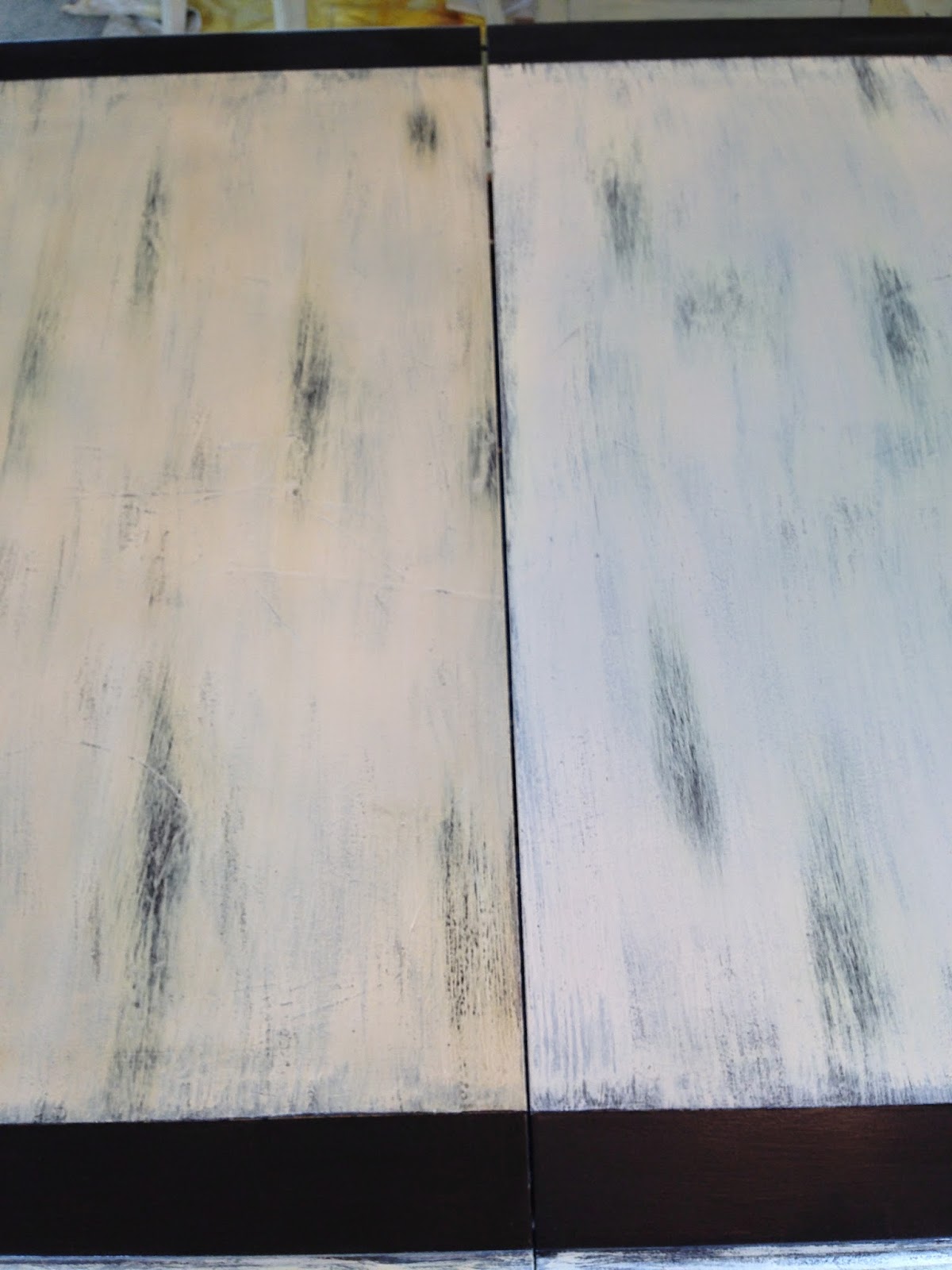


One coat of stain over everything.


One coat of stain on the left and two coats on the right in the picture.


You don't have to use the stain process - I just go crazy for how it mellows any color.  You're almost done!  Next...

DO NOT SKIP THIS STEP:  After the stain dries, put on at least two coats of polyurethane (drying between each coat).  The polyurethane will protect all of your hard work.  You don't want the paint to come off during a dinner party! I use a polyurethane that actually has another very light stain in it, but you can always use clear.  I find it goes on better with a foam brush - it seems to create a bunch of bubbles if I use a regular brush.  

And the last thing to do:  Let all of those layers of paint, stain, and polyurethane cure for a week.  It may seem dry, but it needs to cure through all of the layers.  

Buuuuuut, the fun thing to do while waiting for the pieces to cure is RE-COVER THOSE OLD CUSHIONS!

You have already removed the cushions (see pictures way towards the top).  Simply pull off the fabric with staple pullers, a screwdriver, or wrench, as it will be staple-gunned to the bottom of the seat.  In my case, even my husband couldn't get the staples out of the bottom of the seats, so I just cut the material off as close to the staples as possible.  

I saved the foam piece on the matching chairs and plywood seat.  Since the cane was removed from the ladderbacks, my husband made a piece of plywood using the cane seat as a template and I bought new heavy duty foam for these two seats.  

Find a new vibrant material that makes you happy, cut out squares to cover each seat, and then staple gun the new fabric to the underneath of the seat. Staple a couple of staples to one side evenly, then do the same to the opposite side.  Do the same to the other two facing sides, one at a time.  Then put in rows of staples along the sides.  Fold the corners however you like them, kind of like wrapping a package.  There are many ways to to this, so just make it pleasing to you.  Cut off excess.  

You may choose to put a square of felt covering the bottom of the seat and hiding the staples, but I can never figure out why this step is necessary.  If someone is lying under my chairs making comments about the staples, I've got bigger problems!  LOL

Screw your seats back onto your chairs.


Here are two of the chairs completely finished.


Ta da!  From an old nicked- and scratched-up pine dining set with one chair missing, I have a new dining set that I can be proud of.  You can see I left the ladderbacks solid chocolate to match the border of the table, but covered the seats to all match.  


I quite like the way this project turned out - and I promise you that it's not difficult at all!  You can't mess it up because it's supposed to look old and lived-in.  If you have any questions, just let me know!  I hope you enjoy your own project and send me a picture!!

Danette


Friday, May 9, 2014

White on White Canvas


While I'm in the middle of redecorating/reaccessorizing my home, I decided to make a few meaningful canvases for my bookshelf.  I found this one intriguing.  This white-on-white thing is kinda trendy right now, and I wanted to see if I could do it.

First, you have to have a canvas board the size you'd like for the place you'll be putting it (I found mine at Joann's).  Then, you need to decide what to write on it.  In my case, I decided to write "I love you" in as many languages as I find interesting.  After the romance languages, I also included fun things, like all languages that make up the genetics of our family - and even wonderfully geeky things like elven, troll, and even pig latin. ;-)

I used Word to type out all of the different "I love yous," then decided that I wanted them all in different fonts, so I played with that for a while until I liked the fonts.  Then I played with the sizes of each different language phrase.  This is all a bit of trial and error and depends solely on your taste and preferences.  You could do the entire board in one font and one size and not go through any of that: it's totally up to you.  You could even just put one poem or phrase on the entire board.  Whatever makes you happy.


Below, you'll see that I printed out all of the phrases and cut them out.  I put a piece of cling wrap over my canvas and started laying out the placement of the phrases.  This is what I came up with.  I glued them down with a glue stick onto the cling wrap.  This is your layout.


Next, lay a piece of wax paper over your word layout and use white puff paint to trace them.  You will get some of the letters wrong - don't worry, just make more until you're happy with them.  You do not have to paint over them in the same order as the layout.  You are just making the letters here. If you don't like a letter, make another one right next to it.  Let everything dry overnight.  

I put a piece of black material underneath so you could see the letters better.  You can see how I messed up on a few letters and re-did them.  You can also see how they can be easily peeled off.


When the paint is dry, you can start carefully peeling them off and placing them directly onto the canvas in the order of your layout.  In this photo, I have the dry painted letters on the left and the mock-up layout on the right to use as a template as I place the letters.  Can you see where I've started placing the letters on the canvas?


The letters should peel off pretty easily.  If you have any problems, just remember that you can always make more.


Here, I have placed all of the letters according to my template (well, for the most part - you can see some are still crooked).  You can see they aren't perfect yet.  I pushed them around with a toothpick for a while until I had them exactly where I wanted them.


Then I carefully used Mod Podge to glue the letters down.  When they were all glued down, I put a couple more layers of Mod Podge over the top of them.


This is the finished product.  It's much easier to read in person.  LOL  My favorite part is that people tend to do a double take when realizing there are words on the canvas.  


If you don't like the white on white, you can always use different colored puff paint for the letters, or even use white puff paint, but paint the entire canvas at the end to make it red on red or green on green, etc.  Anything goes on this one.  Enjoy!


Sunday, May 5, 2013

The Reading Wreath

You all know I've been crafting up a storm lately, and I decided to try to make roses out of book pages.  Most everyone in my family loves to read, so I thought it would be appropriate to make a wreath out of them.  It's kind of a zen process and gives me time to think, so I thought I'd take pictures of the process and make a tutorial of sorts.  For those who are interested, I give you The Reading Wreath:

You will need an old book you can rip the pages out of, scissors, and a cool glue gun with lots of glue sticks.  Not kidding here:  Don't try this with your super hot glue gun.  You will not have any skin left.

Now fold one corner of your page down to meet the opposite edge, like above.  We're going to cut it into squares.

Cut the excess off, as above.


<<You will end up with the square to the left.

Trim the corners - you do not have to be precise.  >>


Now cut a spiral into the circle, leaving a tiny disk shape in the middle (photo on the right).  Again, do not be precise.  Irregular shapes and widths make the roses look unique.

Starting from the outside, start curling the paper.  Start with a tight curl to start it off.

Keep winding...

As you wind towards the middle, you can decide whether you like it tighter or looser.  Keep winding...

This is what it looks like from the side.  Keep winding until you get to the little disk-shaped end.

This is what it looks like from the bottom after it's all wound up.  See the little disk shape flipped up at the top?  Now squirt a blob of glue right into the center.  This will hold all of those layers together...

And then close the disk flap down onto the glue to hold everything in place.


<<You may end up with something like this.  I personally didn't like the piece that was sticking out, so I always go around and dab glue into the very bottom of the outside petals to secure them and to place them where I like.  Finished product >>

Experiment with using different sizes of pages, which give you a bigger variety of rose sizes and shapes.

Now you're going to glue them to the wreath.  Since I didn't want green to show through between the roses, I wanted to spray paint the wreath white.  Unfortunately, I ran out of white spray paint because of the porousness of the foam.  I figured knocking the green down to light green was good enough and moved on.  :-)

For finishing my wreath, I have my sorta painted wreath, finished roses in three sizes, and my Dangerous Killer Take Your Skin Off glue gun.  I decided to use this glue gun for this part as I need the roses to adhere stronger than a cool glue gun can plus my skin doesn't come in contact with the glue (in theory).  

Now just go for it.  I just started using the biggest and prettiest ones on top where people will see them most,  filled in the outside and inside, and used my tiny baby roses from really small books to fill in.  Photos below.


All done!  

You could tea stain the top edges of your roses, too.  Add a bow.  Add a wooden letter.  Or give me another idea!  I'm sure this won't be the last one I make.  The front door might need a colored one with the wooden numbers of our house number.  Hmmmm....